Bastion+ in WebRTC mode
Description of a typical Bastion+ installation in WebRTC mode, providing protocol breaking and access to a work environment
Prerequisites
License & Ansible: Reemo API license key and access to the
reemo-infrarole.DNS resolution:
Portal:
url.domain.tldAdmin:
admin.domain.local
SSL certificates:
.pemfiles (Cert + Key) for Traefik.Image access: valid account on the Reemo Docker registry.
Architecture
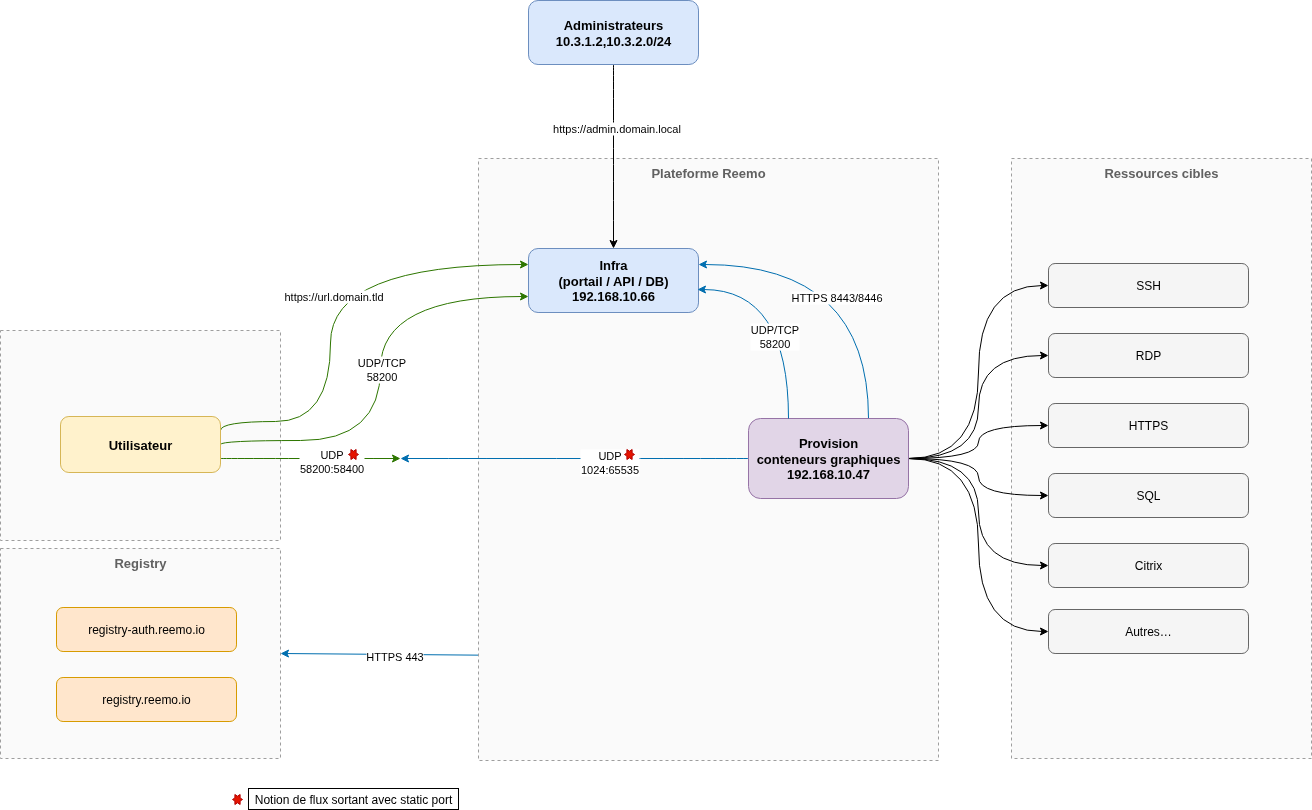
Overview of the infrastructure for a Bastion+ installation in WebRTC mode
Sizing (10 concurrent sessions)
Machine |
CPU |
RAM |
Disk |
|---|---|---|---|
infra_manager1 |
4 vCPU |
8 GB |
100G SSD |
provision1_manager1 |
10 vCPU |
10 GB |
100G SSD |
Flow matrix
DESCRIPTION |
TRANSPORT |
SOURCE IP |
SOURCE PORT |
DESTINATION IP |
DESTINATION PORT |
SERVICES |
|---|---|---|---|---|---|---|
INFRA -> PROVISION |
TCP |
192.168.10.66 |
1024:65535 |
192.168.10.47 |
8443 |
HTTPS |
PROVISION -> INFRA |
TCP |
192.168.10.47 |
1024:65535 |
192.168.10.66 |
8443,8446 |
HTTPS |
PROVISION -> INFRA |
UDP/TCP |
192.168.10.47 |
1024:65535 |
192.168.10.66 |
58200 |
STUN/TURN |
INTERNET -> INFRA |
TCP |
WAN |
1024:65535 |
192.168.10.66 |
443 |
HTTPS |
INTERNET -> INFRA |
UDP/TCP |
WAN |
1024:65535 |
192.168.10.66 |
58200 |
STUN/TURN |
INFRA -> REGISTRY |
TCP |
192.168.10.66 |
1024:65535 |
registry.reemo.io, registry-auth.reemo.io |
443 |
HTTPS |
PROVISION -> REGISTRY |
TCP |
192.168.10.47 |
1024:65535 |
registry.reemo.io, registry-auth.reemo.io |
443 |
HTTPS |
Ansible inventory file
all:
  vars:
    API_LICENSE: "< LICENSING_KEY >"
    REGISTRY_URL: "registry.reemo.io"
    REGISTRY_ENV: "reemoinfra"
    REGISTRY_USERNAME: "< username >"
    REGISTRY_PASSWORD: "< password >"
infra_manager:
  vars:
    TRAEFIK_SSL_CERTS:
      - cert_file: "/local/path/ssl/cert.pem"
        key_file: "/local/path/ssl/key.pem"
    PORTAL_URL: "url.domain.tld"
    PROVISION_SIGNAL_IP:
      - ip: "192.168.10.66"
    INIT_PROVISION:
      provision1:
        type: "SWARM"
        ip:
          - "192.168.10.47"
    PORTALADMIN_URL: "admin.domain.local"
    PORTALADMIN_URL_RESTRICT_IP: "10.3.1.2,10.3.2.0/24"
    PORTALADMIN_TYPE: "instadmin"
    PORTAL_TYPE: "orguser"
    # credential
    CREDENTIAL_ENABLED: true
    CREDENTIALPORTAL_ENABLED: true
    # vault
    VAULT_ENABLED: true
    VAULT_INIT_FILE: "/path/file/init.crypt"
    TURN_ENABLED: true
    TURN_OVERRIDE: true
  hosts:
    infra_manager1:
      ansible_host: "192.168.10.66"
provision:
  children:
    provision1_manager:
      hosts:
        provision1_manager1:
          ansible_host: "192.168.10.47"
Ansible playbook file
reemo-infra.yml
- name: Installation Reemo Infra Server
  hosts: infra_manager
  gather_facts: "True"
  roles:
    - role: reemo-infra
      become: yes

- name: Installation Provision
  hosts: provision
  gather_facts: "True"
  roles:
    - role: reemo-infra
      become: yes
Installation
# Initial deployment — run only once
ansible-playbook -i inventory.yml playbooks/reemo-infra.yml --extra-vars "INIT_DB=true" --extra-vars "INSTALL_DOCKER=true"
Securing the Vault (ansible-vault)
Immediately after the first deployment, you must:
Save the
init.jsonfile in a secure location (password manager, vault, offline encrypted backup).Encrypt the local file with
ansible-vault.
Initial encryption
Right after the first deployment, encrypt the file:
ansible-vault encrypt playbooks/secrets/reemo/vault/init.json
Ansible will ask for a strong passphrase (also save it in your password manager).
Note
The passphrase is different from the contents of init.json. Save both: the contents of init.json and the ansible-vault passphrase.
To run the ansible-playbook command again afterward, you will then need to provide the password for this file:
ansible-playbook -i inventory.yml playbooks/reemo-infra.yml --ask-vault-pass
Important
If you are using self-signed SSL certificates (test environment only),
close Chrome completely, then launch it with the --ignore-certificate-errors option:
"C:\Program Files\Google\Chrome\Application\chrome.exe" --ignore-certificate-errors
Adjust the path if needed.