Manage Composites
A Composite groups screens from one or more source computers into a single virtual resource, which then behaves like a regular workstation — visible in the Remote Desktops list, assignable to users, groups, and collections. Composites are commonly used to replace a physical KVM switch, for example to display a video feed and a monitoring feed side by side.
Access: inventory_2 Inventory > tv Remote Desktops. Use the All / Computers / Composites toggle to filter the list to composites only — see Manage Workstations.
Composite Status
Since a composite aggregates several source computers, its status reflects the combined state of all its sources:
Online: all source computers are online.
Busy: at least one source computer has an active session.
Partial: some, but not all, source computers are online.
Offline: all source computers are offline.
Creating a Composite
Go to inventory_2 Inventory > tv Remote Desktops.
Click New Composite.
Fill in the form:
Name (required): the composite’s label.
Description: optional.
Icon (SVG): optional — paste an SVG to use as the composite’s icon.
Click Create.
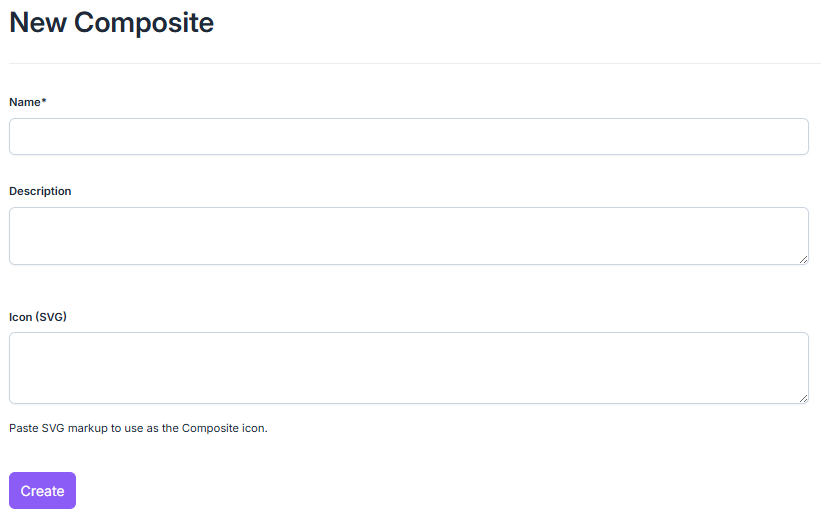
New Composite form.
The composite appears in the Remote Desktops list with the type Composite. Assigning it to users, groups, or collections works the same way as for a computer — see Assign Users to a Computer.
Composite Profile
Click a composite’s name to open its profile.
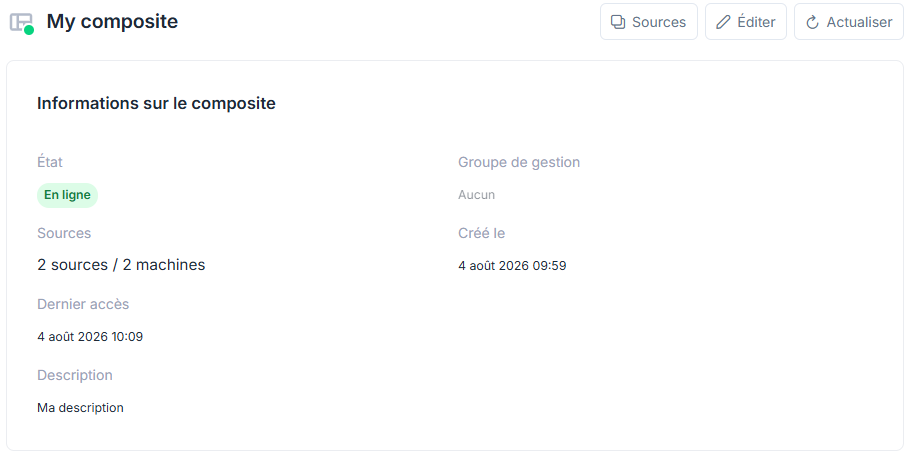
Composite profile.
The Composite Information card displays:
State: real-time status — see Composite Status above.
Sources: number of configured sources and underlying machines (a machine used as more than one source is counted once).
Managing Group, Created At, and Last Access.
Description.
Available actions:
Sources — configures the composite’s sources, see Configuring Sources below.
Edit — modifies the composite’s Name, Description, and Icon.
Refresh — updates the composite’s information and status.
Available tabs: Users, Groups, Collections, and Delete — same as a computer profile, see Available tabs.
Configuring Sources
Click Sources on a composite’s profile to add, remove, or reorder the screens it projects.
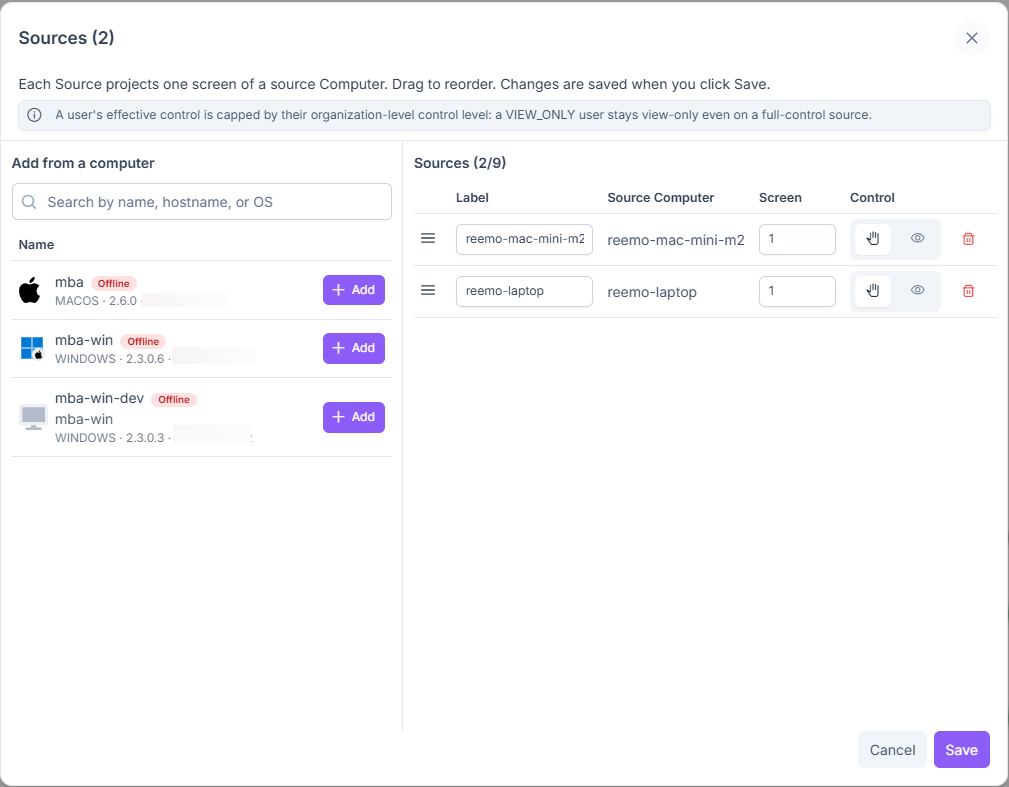
Sources configuration window.
Search for a computer in the Add from a computer list and click Add. A composite can hold up to 9 sources, and the same computer can be added more than once to project several of its screens.
For each source, configure:
Label: editable name shown in place of the source, for example in the toolbar.
Screen: the screen number to project from that source computer.
Control: whether users connecting through this source get full control () or view-only access ().
Drag a source using its handle (☰) to reorder it in the list.
Click Save to apply your changes, or Cancel to discard them.
Note
A user’s effective control on a source is capped by their organization-level control setting: a VIEW_ONLY user stays view-only even on a source configured for full control — see Starting a Session in View-Only Mode.
Launching a Composite Session
When you connect to a composite with more than one source and your local machine has multiple displays, a screen-mapping dialog appears before the session starts.
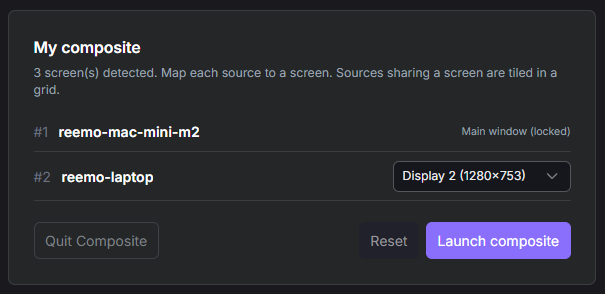
Composite launch dialog.
Each configured source is listed and can be mapped to one of your local displays. Sources mapped to the same display are tiled in a grid.
The first source is mapped to the Main window and cannot be changed.
Click Reset to restore the default mapping, or Quit Composite to cancel.
Click Launch composite to start the session with this layout.