Network flows and ports
Reemo exposes few inbound ports: most flows originate from clients and agents toward the platform. This page summarizes the main flows and ports; the full detail is in the network matrices.
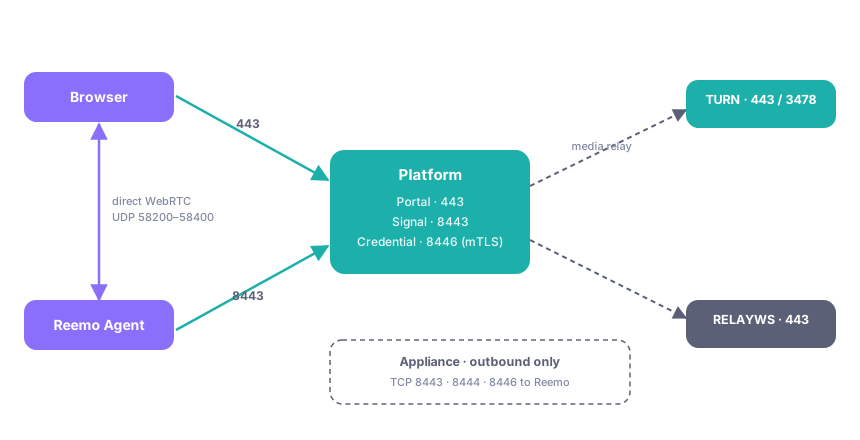
The main flows between the browser, the agent, the platform, and the relays.
Ports exposed by the platform
On the infrastructure side, the main listening ports are:
Portal (users): 443 (HTTPS), via Traefik.
Signal (Reemo agents): 8443 (HTTPS).
WebSocket relay (RELAYWS): 443.
Portal Credential: 8446 (HTTPS, mTLS).
Media flow
Once the session is negotiated, the media flow takes one of the following paths:
Direct WebRTC: UDP, range 58200–58400 by default, between the client and the agent.
Relayed WebRTC (TURN): to the TURN server, on port 443 (Reemo relay) or 3478 (for example Cloudflare).
WebSocket (RELAYWS): HTTPS on 443, through a dedicated relay container.
Appliance: outbound-only flows
The APPLIANCE environment requires no inbound opening: the connector initiates an outbound connection to the Reemo infrastructure (TCP 8443, 8444, 8446) and to the ancillary services (registry and downloads on 443, TURN on 3478). No inbound flow is required toward the network that hosts the containers.
Internal trust
Between micro-services, communications are encrypted with mTLS over an internal PKI. In a cluster, Docker Swarm nodes exchange over an overlay network (UDP 4789).
See also
Flow matrix (Public Cloud) — All flows, addresses, and ports on the browser and agent sides.
See also
Flow matrix (Private Cloud) — The flows for a dedicated instance.
See also
Flows and inbound ports — The reference table of the instance’s listening ports.